Visallo – plug and play cognitive technology

VisalloCognitive

Cognitive Technology

In its simplest form, cognitive technology is software mimicking the human brain. A human brain can read text, listen to sound and spot objects in videos. A human brain understands context, it can learn from previous experience and it can adapt as new information comes its way. In short: the human brain is brilliant. Why would we use anything else?

Well, we are in an age of data generation. On average users of the Internet generate 2.5 quintillion bytes of data each day. It’s not just reserved for the Internet either, companies are generating more internal data than ever and as storage becomes cheaper the data only grows.

The key to a company’s success may be hidden in their own data. The meaning of life may well be held on the Internet; you never know.

With this newly acquired data comes great opportunity. The key to a company’s success may be hidden in their own data. The meaning of life may well be held on the Internet; you never know. The problem of course is the sheer volume. The task of understanding the data and obtaining anything useful from it is impossible to do manually; although I’ve seen people try!

This is where cognitive technology comes in. Forms of artificial Intelligence, computer vision, machine learning, natural language processing and speech recognition; that can be used to understand the data for us. It is only then that we can then gain intelligence from the huge amount of data. All that is needed is an analytics system with cognitive technology…

All that is needed is an analytics system with cognitive technology…

Build your own

One option is to build a system from scratch.  By cherry picking the best technology companies (as well as open source resources) that provide cognitive analytics. You could feed data to and from these technologies into the system. You could pick a high-performance graph database to deal with the data and build a cutting edge browser-based UI to give statistical and visual analytics to the users.

This option is a viable but costly one. It will require a good solutions architect who understands the problem, some high-end developers, a data scientist and a project manager. It’s also a time-consuming proposition. You aren’t going to be getting results tomorrow.

Off-the-shelf

Why build something when somebody else has already developed it? Another option is to buy an ‘off the shelf’ solution. Here the deployment will be fast, you will get support when you get stuck and the UI and back end database have already been thought through.

This option is appealing and may be cheaper. It is common though that you are then tied in to any technology that the software vendor has partnered with. This may mean: if you want improved voice recognition or natural language processing in Arabic, you may not find the solution you want.

Visallo – Plug ang Play Cognitive Technology

Visallo is one of the ‘off the shelf’ solutions described above. It is based on a high-performance graph database and it allows users to perform: statistical, visual (graph), temporal and geo-spatial analysis all from one intuitive browser-based UI.

Visallo

Visallo

While that is all appealing, the interesting part to Visallo is their attitude to extension and customization. They actively encourage it. Jeff Kunkle, the President of Visallo actually wrote a blog entitled ‘We love when customers replace our software’

Visallo was designed with extension and customization in mind. From the underlying data store to data processing algorithms and UI plugins, you’re not stuck with a one-size-fits-all solution.

This means if the default OpenNLP plug-in that analyses text and extracts entities (People, Organisations, Locations and Vehicles) from unstructured data doesn’t fit your needs; choose another one. If you want to integrate with you existing investment in voice recognition technology; no problem.

analyticplugin

Plug and Play

This attitude to ‘plug and play’ technology allows the fast deployment and support of an off-the-shelf product, with the flexibility of a build-your-own solution.

For more information on Visallo visit their website or contact S-branch to find out more. If you’d like to find out more about cognitive technologies and the application into crime and fraud; feel free to call.

S-branch offers independent advice, so even if Visallo is not for you, we can help you find the solution that is.

Tackling duplicate data in i2

Smart Matching

Duplicates in data is always an issue. An issue which is magnified once you start trying to load said data into a visual analysis tool like i2. The nature of tools like i2 is that they find connections between entities; in order for that to work the data must be clean a free of duplicates.

In reality, it’s not always feasible or realistic to get rid of all duplicates. For this reason, the i2 analysis suite does provide some matching functionality

Smart Matching – i2 Analyst’s Notebook

To explain it in a simple way: Smart matching in analyst’s notebook is achieved by categorising entities and applying almost human matching logic.

For example, a visualisation may contain a police officer, a victim, a suspect, a prisoner, a male and a female entity. These entities could all be categorised as People. As humans, we could look at a list of people and would instinctively apply matching logic. We’d know that date of birth was important. As are surnames, although they may change when someone marries. We know that Chris could be spelt in several different ways and (as with any data) there may be spelling mistakes.

i2 smart matching can do the same thing. It will apply a different set of logic to different categories of entities to give an almost human matching ability.

Smart matching example

Smart matching example

Great! Problem solved! Well yes, if you have a smallish set of data then smart matching will work well. However, for smart matching to work, the entities need to be on an analyst’s notebook chart. This may start becoming an issue once you hit the 20,000 entities mark! You could try some kind of batching process but it’s likely to be time-consuming and not entirely accurate.


Matching in iBase

Matching in iBase example

Matching in iBase example

iBase will not have this problem. Being a database it will have access to all of your records without needing to render them on a visual chart. The problem we have in iBase is it doesn’t have access to the same smart matching logic. With iBase we can match someone with exactly the same surname. Or, the exact same surname and date of birth. While useful, this will miss a lot of duplicates and therefore needs to be used with care.

Custom Matching Functionality

For some of our clients, the functionality described above didn’t meet their needs. They either had too many entities or wanted to find duplicates of completely different entity types, or maybe over different databases.

For these clients s-branch developed an external matching solution, using an existing string matching theory called Levenshtein distance. Levenshtein distance is a string metric for measuring the difference between two sequences. Informally, the Levenshtein distance between two words is the minimum number of single-character edits (insertions, deletions or substitutions) required to change one word into the other. What’s great about using Levenshtein distance is that it gives us a score. Meaning we can see narrow down our results to only the most relevant matches.

Custom matching example

Custom matching example

The external matching is computed outside of iBase. This is done to minimalise the effect on database performance but also allows us to iterate through entire datasets programmatically. This means we can compare duplicates regardless of whether they are the same entity type; or even the in the same database. The output from this is a matching score which is then imported into iBase as a ‘AutoMatch’ link. Our clients can then use existing iBase functionality, such as queries and sets to review the matches found and if applicable merge them through the normal UI.

You can read more on Levenshtein distance here.  To find out more about using Levenshtein distance with iBase or to discuss your own duplicate problem, please contact us

INTERPOL Firearm Forensics Symposium (IFFS) – 2017

In October 2017 I was asked by Arquebus Solutions to speak at the IFFS, an event designed for individuals who investigate firearms-related crimes, heads of police agencies and those who shape policy aimed at combating firearm crime.

It was an honour and a privilege to speak at such an event. It was also fascinating and humbling to hear experts share lessons learned following the recent terrorist attacks in Europe and other parts of the world.

Firearm Focal Points

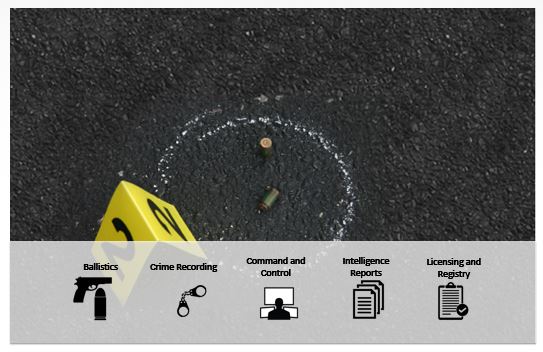
One point which was consistent throughout the event was Firearm Focal Points (FFPs). FFPs are designed to collect all the necessary firearm information together, creating accurate investigative leads thereby helping both investigators and prosecutors to tackle the problem at source.

Firearm Focal Point

Firearm Focal Point

FFPs work because of data collaboration. Analysis of ballistic evidence has advanced hugely but this information should not be analysed on its own. If a cartridge case is found at a location what other crimes have we seen in that area? Were there any ‘shots fired’ call outs at that time? We may know that the cartridge case comes from a particular type of firearm. What intelligence do we have about trafficking those types of firearms? If we are lucky enough to find or have a match to a particular firearm; who is it registered to? Is there any link to other crimes?

We can only answer these questions if we have access to all the information. Analysis tools allow us to understand this information quickly, helping FFP’s provide accurate leads fast. It was my job to showcase how analysis tools can aid investigations when this data is made available.

Arquebus and I worked together to implement the Kosovo FFP. The success of this deployment was collaborated by Kosovo Police, who also spoke at the conference. It was with great pride that I listened to real cases where the collaboration of ballistic and crime information had aided investigations.

Crime in Action

A unique feature of IFFS 2017 was the ‘Crime in Action’ simulation, which ran through the entire conference. Subject experts shared their experiences and expertise not only through presentations and interactive panel discussions but also as part of a ‘crime in action’ scenario.

IFFS

IFFS

It was great to see all of the skills and expertise employed in dealing with a live gun crime investigation, but also to see how areas such a legislation, policy making, joint working arrangements and international development all play a part in how we deal with gun crime and illicit arms trafficking.

The highlights for me were visiting a simulated gun crime scene and the final arrest which occurred in the middle of the conference, much to the surprise and delight of the delegates.

In summary, it was one of the best conferences I’ve attended and I hope to return either as a delegate or presenter in the future.

S-branch i2 Consultancy

i2 Consultancy

i2
Since 1990 i2 has been providing its clients with accessible and intuitive data analysis tools. Analyst’s Notebook has now become the standard for charting data and is used in nearly all of the UK police forces. The potential of Analyst’s Notebook sitting on top of a database was very quickly understood. This understanding spawned the release of iBase, iBridge and later on enterprise solutions such as IAP.

This movement towards visualising larger datasets made the offering applicable to not only law enforcement but to government agencies, military, and commercial clients as well. If you have a sporadic flow of data in formats that vary greatly, i2 is still one of the most compelling tools on the market.

If you have a sporadic flow of data in formats that vary greatly, i2 is still one of the most compelling tools on the market.

S-branch i2 Consultancy
We’ve been part of the i2 journey since 2006, either as trainers, technical consultants or marketers. Through these roles, we’ve worked with several police forces both in the UK and abroad, charities, insurance firms, law firms, government agencies and commercial clients.

Here are some of the ways S-branch can assist i2 users:

  • Schema Design – By far the most important part of any i2 deployment. Understanding the data landscape and the client’s needs are more important than technology. S-branch has many years experience with thinking in ‘Entity and Links’ and can apply this to new and existing i2 deployments
  • Implementation – i2 has a straightforward deployment model which fits well with most IT infrastructures. The integration with other data sources or systems is the technical part. S-branch has experience with working with various I.T departments and third-party providers to assist with this
  • Health Check – Like anything complicated, an i2 deployment could do with a check-up every now and then. If a client has had their deployment for a while or is worried about any aspect of its setup, S-branch can assist with this.
  • Enhancements – i2 does a lot of things very well but no tool does everything. The idea of moving to a different platform just to get that one piece of functionality is daunting. S-branch has experience in enhancing the product set, to ensure the client gets the best out of their existing investment. This has ranged from: data washing, alerting, advanced duplicate detection and even advanced pre-processing to get more out of their data.
  • i2 Administration – i2 is often a ‘mission critical’ system for a lot of our clients. Having an administrator that knows the software inside and out, as well as the underlying technology is a reassurance. To these clients, S-branch can be that semi-regular resource that can be called upon.

If any of the above could benefit your i2 deployment or you’re looking into data analysis tools in general; please feel free to contact us.

S-branch brand is formed

Connected Forest S-branch -Trusted Analytics

Following an initial period of successful freelancing, I’m delighted to announce that the S-branch brand has now been set up.

I’d like to thank all of our existing customers for their support so far and will ensure that the transition is a painless one.

S-branch will continue to assist it’s clients in identifying crime and fraud in large amounts of data. While experienced with individual pieces of software, S-branch will remain software agnostic ensuring our clients get the best solution for their needs.